There is a specific kind of liminal exhaustion that belongs exclusively to the business traveller.
It is not the tiredness of physical exertion. It is not the satisfying depletion of a day of focused work completed in a familiar environment. It is the compound fatigue of compressed time zones, recycled cabin air, the low-grade hypervigilance of navigating airports and customs and ground transportation, and the sustained performance of being professionally present across a day — or two days, or four — in which the environment has been entirely outside the traveller’s control.
The flight lands at Pearson. The bags come off the carousel. The car service or the rental is waiting. And somewhere between the terminal and the highway, the question that most business travellers do not ask themselves — but probably should — is what happens next.
The default answer is the hotel. A room, a minibar, a television, and the particular quality of ceiling that business travellers have memorised in forty cities. Sleep that comes reluctantly and leaves too early. A morning meeting for which the traveller is present in body but not quite in the full sense that the meeting deserves.
There is a better answer. It has been at the same address since 1991, and it is less than thirty minutes from Terminal 1.
The Geography of the Window
Toronto Pearson International Airport sits at the western edge of the GTA, at the junction of Highway 427 and Highway 401 — two of the region’s primary east-west arteries. From Terminal 1, the drive east along the 401 to the Woodbine Avenue exit in Markham runs between twenty-five and thirty-five minutes in typical evening traffic, longer during the peak of the evening rush but consistently manageable by the time most international arrivals clear customs and collect luggage.
Club Dynasty at 7850 Woodbine Avenue sits less than five minutes from the 401 interchange. The total transit time from the terminal to the facility — for a guest who knows the route — is within the window that most business travellers spend deciding whether to order room service or eat at the hotel restaurant.
For guests staying anywhere along the Highway 404 corridor, in Richmond Hill, in North York, or in Markham itself, the routing is even cleaner. The facility sits naturally on the path between the airport and the hotel, which means the decompression window does not require a detour — it requires a decision.
For guests whose meetings are in downtown Toronto, the calculus is slightly different but the window still exists. The 401 to the DVP connects cleanly. The visit becomes the middle of the evening rather than the last thing before the hotel, which suits a certain kind of traveller considerably better than arriving at a downtown property already spent and having nothing between the lobby and the ceiling.
What the Body Carries Off a Transatlantic Flight
The physiological state of a business traveller arriving at Pearson after a long-haul flight is specific enough to deserve a plain description.
Cabin pressure in commercial aircraft is maintained at the equivalent of approximately 6,000 to 8,000 feet of altitude — sufficient to reduce blood oxygen saturation measurably and to produce the mild but sustained cognitive and physical effects that passengers describe as the flatness and heaviness of a long flight. Cabin humidity runs at between 10 and 20 percent — significantly drier than most environments on the ground — which produces the dehydration effects that accumulate across a flight regardless of how much water a passenger drinks. The immobility of a long-haul seat — even a business class flat bed, which addresses some but not all of the postural loading of economy — produces the specific muscular stiffness that most travellers recognise in the lower back, the hip flexors, and the neck.
Add to this the circadian disruption of crossing multiple time zones, the sustained alertness required to navigate an international airport, and the residual activation of whatever professional demands preceded the flight, and the arriving traveller is carrying a physiological load that the hotel room is structurally poorly equipped to address.
The hotel room offers horizontal rest, which addresses the immobility component partially. It does not address the muscular tension, the nervous system activation, the circulatory stagnation of several hours in a pressurised cabin, or the specific dehydrated-but-wired state that most long-haul travellers arrive in and that makes the sleep they badly need harder to access than it should be.
Why the Decompression Window Matters
The argument for using the window between the airport and the hotel for something more deliberate than transit is not about luxury. It is about function.
A business traveller who arrives at a hotel in the physiological state described above and attempts to sleep tends to experience the specific frustration of a body that is exhausted but not recovered — tired enough to want sleep, activated enough to resist it. The jet lag component compounds this. The result is often a night of compromised sleep that produces a morning meeting at sixty or seventy percent of the traveller’s actual capacity, which is a meaningful deficit when the meeting is the reason for the trip.
A business traveller who uses the ninety minutes between the terminal and the hotel to move through a proper decompression circuit arrives at the hotel in a qualitatively different physiological state. The muscular tension of the flight has been addressed. The nervous system has been taken through the hot-cold contrast cycle that produces the parasympathetic rebound most conducive to subsequent sleep. The circulatory stagnation of several hours of immobility has been reversed. The body is genuinely tired rather than activated-and-exhausted, which are not the same thing and do not produce the same quality of sleep.
The morning meeting is attended by a traveller who slept rather than one who merely lay down.
The Full Circuit at Club Dynasty
Club Dynasty’s 10,000 square foot facility at 7850 Woodbine Avenue is operational every day from 11 AM to 1 AM, with no appointment required — which means it is structurally available for the business traveller regardless of when the flight lands, when customs clears, or how the ground transportation runs.
The facility’s amenity circuit addresses the specific physiological load of a long-haul arrival with a comprehensiveness that no hotel wellness centre approaches. The 104°F hot jacuzzi pool begins the muscular vasodilation and circulatory response that reverses the stagnation of hours in a pressurised seat. The dry sauna and steam sauna extend and deepen the thermal response, raising core body temperature in a way that primes the body for the pronounced parasympathetic rebound that follows. The ice plunge pool — maintained at a temperature that produces the genuine cold shock and adaptation response rather than a merely cool rinse — delivers the autonomic reset that most directly supports the subsequent sleep quality that the traveller needs.
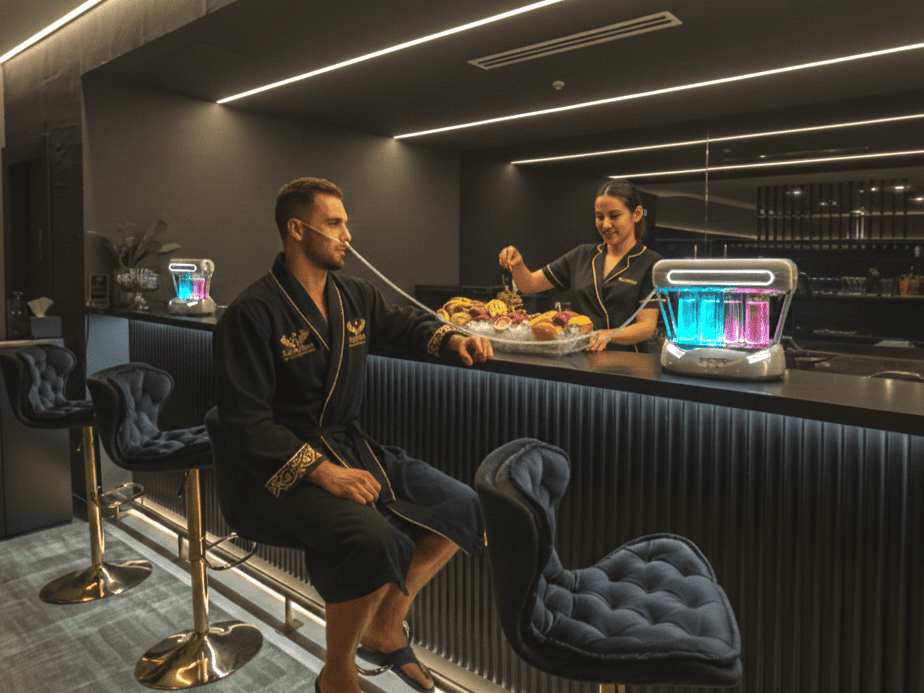
The oxygen therapy bar is particularly relevant for the arriving long-haul traveller. Concentrated oxygen in a relaxed, seated environment during the transition between the thermal circuit and the massage room offers a direct counterpart to the mild hypoxia of several hours at cabin altitude. Many guests who incorporate oxygen therapy into their circuit report a specific quality of clearing — a lifting of the cognitive flatness that accumulates across a long flight — that takes longer to resolve through rest alone.
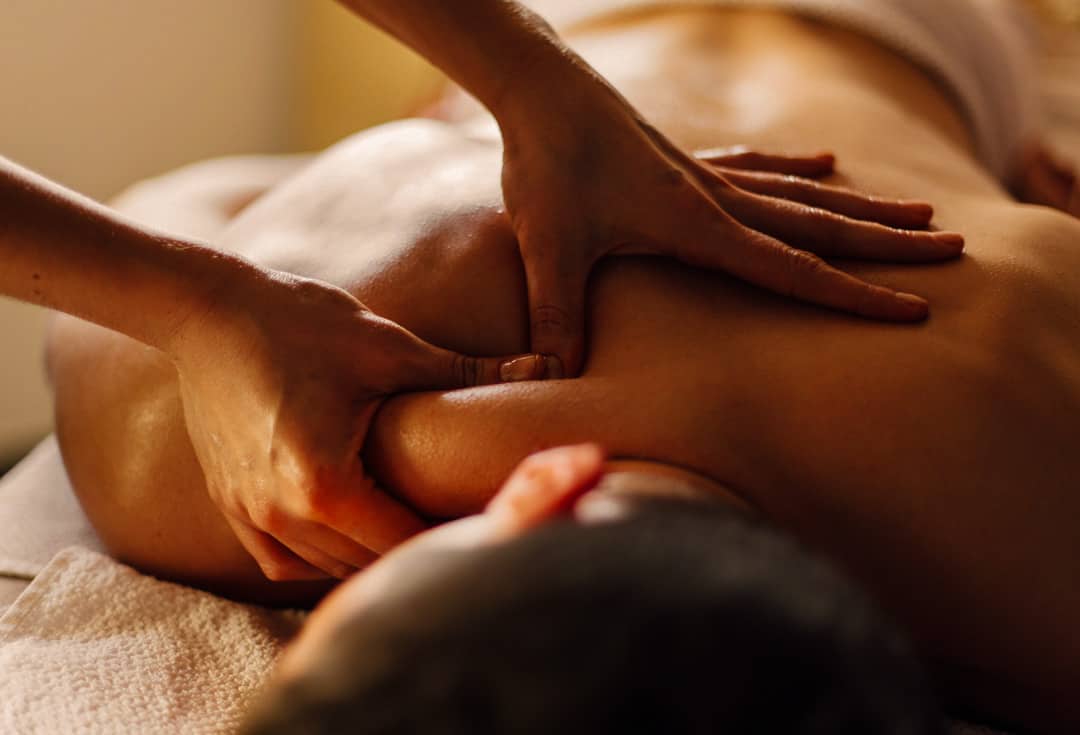
The massage component completes the circuit. A Shiatsu deep tissue session addresses the specific postural loading of the hip flexors, lower back, and neck that long-haul immobility produces — the tissue is warm from the thermal circuit and responsive in a way that makes the deep pressure work significantly more effective than it would be on a body arriving cold from a car. A Sensual Massage, part of the broader exotic massage offerings, addresses the broader nervous system state, producing the oxytocin release and cortisol reduction that directly support the transition toward sleep. The Dynasty Massage with two synchronised attendants covers both functions simultaneously for guests whose time window allows for a more complete session.
The live masseuse schedule is available before the drive from the airport, which removes the only uncertainty a spontaneous visit might otherwise introduce. The pricing is published and consistent — no negotiation at the door, no revision of the advertised rate once a guest is inside. The first-timer’s guide covers the practical questions for guests whose previous Club Dynasty visits have been infrequent enough to warrant a refresh.
The Outbound Window
The arrival window is the most obvious use case. It is not the only one.
Business travellers with early morning departures from Pearson face the reverse version of the same problem — the need to decompress from a demanding engagement before a flight rather than after one. A late evening visit to Club Dynasty before an early departure compresses the recovery cycle into the available window in a way that makes the subsequent flight considerably more restful. The traveller boards already decompressed rather than carrying the accumulated load of the engagement into a pressurised cabin for eight hours.
Travellers with a layover window — connecting through Toronto with several hours between an arriving and departing flight — represent a third use case that the no-appointment, walk-in model at Club Dynasty serves particularly well. The geography from Pearson makes the round trip viable within a substantial layover, and the facility’s operating hours mean it is available through the evening windows when international connections most commonly occur.
For any of these windows, the calculation is the same. The time between the terminal and the next obligation exists regardless of how it is used. The question is whether it is used passively — in a hotel room or an airport lounge — or whether it is used to address the physiological load that the travel itself has produced.
Discretion for the Travelling Professional
The business traveller visiting Club Dynasty occupies a particular position with respect to discretion that is worth acknowledging plainly.
A visit to an executive wellness facility in Markham, on a trip whose primary purpose is professional, in a city where the traveller’s primary relationships are professional — the discretion that Club Dynasty’s operating model provides is not merely a preference for this guest. It is a practical requirement.
Club Dynasty has understood and accommodated this reality for over thirty years. The physical location in Markham rather than in the downtown core provides a natural geographic separation from the professional environments in which being seen matters. The facility’s approach to guest privacy — built into the staff culture, the operational procedures, and the atmosphere of the facility itself — treats discretion as a baseline rather than a premium. The walk-in model means no booking trail, no confirmation email, no record of the visit in a calendar system.
For the travelling professional, this is the facility that was designed with exactly his situation in mind — not because his situation was anticipated specifically, but because Club Dynasty has been serving exactly this category of guest, at this standard, for long enough that the accommodation has become second nature.
The Address Has Not Changed
Club Dynasty has been at 7850 Woodbine Avenue in Markham since 1991. The drive from Pearson has been the same drive for thirty-five years. The facility has been open until 1 AM, without an appointment requirement, across every iteration of the GTA’s development from a mid-sized Canadian city into one of North America’s most significant business destinations.
The business travellers who have made the drive a consistent part of their Toronto circuit — who factor it into the plan as deliberately as they factor in the hotel and the car — have been doing so because the ninety-minute window between the terminal and the hotel turns out to be the highest-leverage hour of the trip. Not the dinner, not the drinks after, not the early-morning run along the lakeshore. The decompression circuit at Woodbine Avenue, after which the night’s sleep is deeper, the morning’s meeting is sharper, and the accumulated load of the travel itself has been genuinely addressed rather than merely endured.
The window exists whether or not it is used. The only question is whether the traveller who has just landed at Pearson knows what is less than thirty minutes east on the 401.
Now they do.